
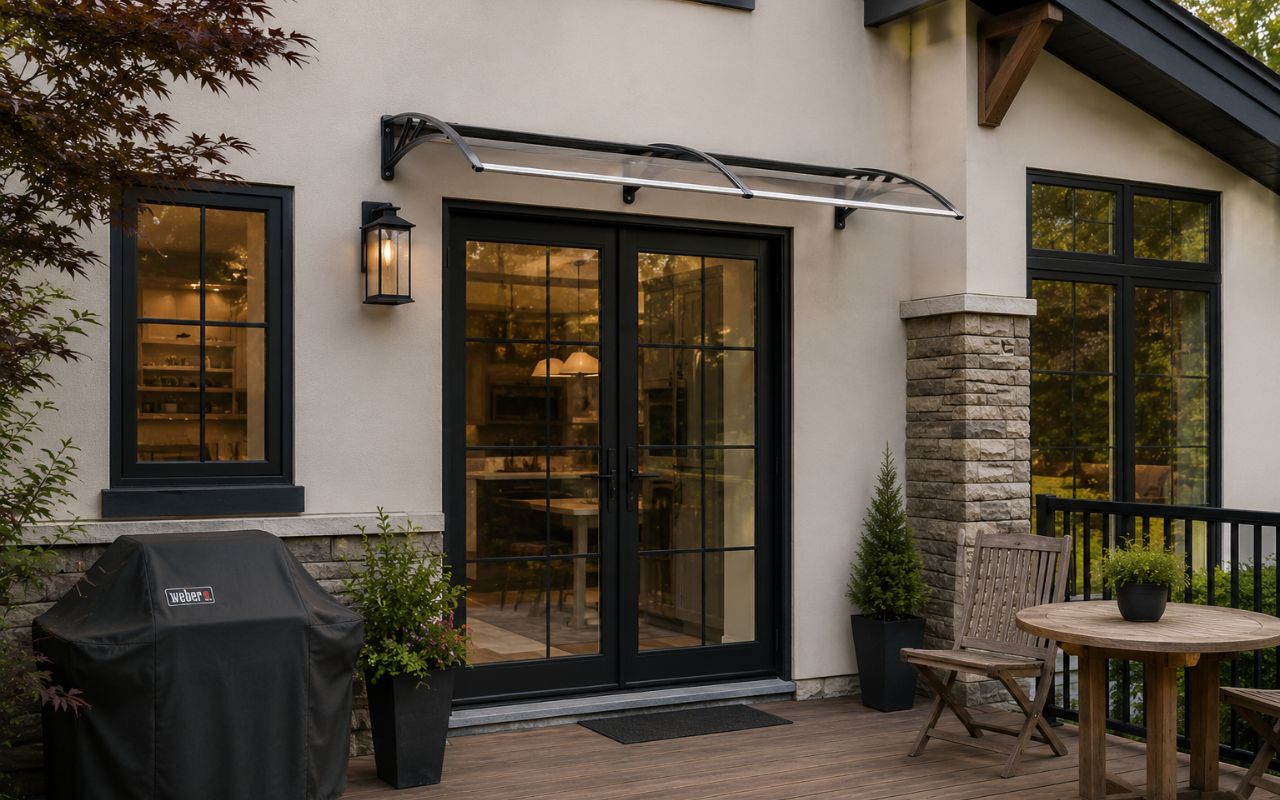
One of the most common questions we receive is: “What size awning do I need for my door?”
The short answer is that you should measure more than just the door itself. After helping Canadian homeowners choose awnings since 2011, we’ve found that the best awning size depends on the entire entrance area, available mounting space, and the amount of protection you want.
Start with the Door Width
A standard exterior door is often 36 inches wide, but every entrance is different.
For a standard 36-inch door, we often recommend a 48-inch awning to create some overhang beyond the door frame. This provides a more balanced appearance and may help accommodate wall lights or other features beside the entrance.
If space is limited, many awnings can be customized to fit the available area.
Measure More Than the Door
One of the biggest mistakes homeowners make is measuring only the door opening.
Before selecting an awning, consider:
-
- Wall-mounted lights
- Security cameras
- House numbers
- Decorative trim
- Downspouts
- Available wall space
The goal is to size the awning for the entire entrance, not just the door itself.
Check the Mounting Space Above the Door
Different awning models require different amounts of mounting space above the door.
We’ve seen customers choose a model they liked only to discover that a soffit, trim, or light fixture left insufficient room for installation.
Always verify the required mounting space for the specific awning model before ordering.
How Much Projection Do You Need?
Projection is how far the awning extends from the wall.
27-Inch Projection
A smaller projection is often sufficient for side doors or entrances with lighter traffic.
36-Inch Projection
For most front entrances, a 36-inch projection offers a good balance of protection and appearance. It typically provides enough coverage for someone standing at the door during rain or snow.
48-Inch Projection
For larger front entrances, a deeper projection may look more proportional and provide additional protection. However, bigger is not always better. An oversized awning can look out of place on a smaller entrance.
Real Customer Examples
Over the years, we’ve helped customers solve many sizing challenges:
-
- A homeowner with a standard 36-inch door chose a wider awning to accommodate wall-mounted lights.
-
- Another customer had limited space between the door and soffit and required a different model with lower mounting requirements.
-
- A homeowner looking for maximum weather protection selected a deeper projection for their main entrance.
Special Considerations for Joined Awning Sections
If you’re joining multiple awning sections together, remember that shared brackets and panel insertion clearances can affect the final dimensions.
When space is tight, these details should be considered before ordering.
Our Best Advice
Before choosing an awning:
-
- Measure more than the door width.
-
- Check the mounting space above the entrance.
-
- Consider lights, trim, cameras, and other obstacles.
-
- Think about where you’ll stand while unlocking the door.
-
- Choose a projection that matches how the entrance is used.
-
- Send photos if you’re unsure.
The best awning size is not necessarily the biggest one. It’s the one that fits your entrance properly, looks proportional to your home, and provides the protection you need.